
Quick Summary
A breaker that trips again the moment it is reset is telling you the fault is still present, and the speed of the second trip is the most useful early clue in the whole job. An instant re-trip usually points at a short circuit or a ground fault. A delayed re-trip usually points at load. Neither is proof on its own, which is why the circuit gets measured rather than guessed at. Big Easy Electricians traces this fault across Orleans, Jefferson, and St. Tammany parishes, and the first thing the crew does is establish what is actually on the circuit, because the directory card inside the panel door is wrong more often than it is right. Estimates are free, and a breaker that will not hold with everything unplugged should be left off until someone has put a meter on it.
Last Updated: August 2026
On This Page
- What Does It Mean When a Breaker Trips Again Right After a Reset?
- What Does an Electrician Check First?
- How Do You Tell a Short Circuit From an Overload?
- What Does It Mean If It Trips With Everything Unplugged?
- Is It Safe to Keep Resetting a Breaker That Trips Immediately?
- Which Faults Turn Up Most in Older New Orleans Houses?
- When Does Repeated Tripping Mean the Panel Needs Replacing?
- How Long Does It Take to Trace a Tripping Circuit?
- Frequently Asked Questions

There is a real difference between a breaker that trips occasionally and a breaker that will not stay on. The first is a capacity conversation. The second is a fault, and it is being held back by the one device in the house designed to stop it becoming a fire. What follows is the order an electrician working in this market actually works through, which is worth knowing even if the job ends up being handed over.
What Does It Mean When a Breaker Trips Again Right After a Reset?
It usually means the fault that caused the first trip has not gone anywhere. A breaker does not remember the previous event, so an immediate second trip is a fresh detection rather than a stuck mechanism. A worn or damaged breaker can also trip on a healthy circuit, so the device itself stays on the list until it is tested.
How quickly it happens splits the problem in two. A breaker that trips the instant the handle reaches the on position is usually seeing a very high current, from a hot conductor contacting a neutral, a ground, or another hot conductor, either in the fixed wiring or in something connected to it. A breaker that holds for seconds or minutes before letting go is reacting to heat from a load it cannot sustain.
That single observation is worth more than any amount of guessing about what appliance might be responsible, and it is free. Anyone calling for help should be ready to say whether the trip was instant or delayed, because it changes what gets checked first and often what gets brought to the door.
What Does an Electrician Check First?
The first move is to establish what the circuit actually feeds, not what the panel label claims. Rooms get added, circuits get extended into rear additions and converted porches, and the directory card usually reflects the house as it was decades ago rather than as it is now.
The working sequence on most calls looks like this:
- Map the circuit properly with a circuit tracer, recording every receptacle, switch, and fixture that goes dead with the breaker off
- Isolate the circuit completely, including hardwired items people forget, such as exhaust fans, doorbell transformers, and ceiling fans
- Test the wiring itself with the load removed, rather than resetting to see what happens
- Inspect the panel for heat damage, loose terminations, and scorching at the bus
- Reintroduce loads one at a time only after the fixed wiring is proven clean
Notice what is not on that list: repeated resetting. Every reset re-energizes the fault, and it is neither a safe nor an informative test once the first re-trip has already answered the question. Structured fault finding of this kind is what electrical troubleshooting work is for, and it usually costs less than the sum of the parts a guesswork approach replaces.
How Do You Tell a Short Circuit From an Overload?
Timing narrows it quickly, though it does not settle it. An overload trips after a delay, often minutes, because the breaker’s thermal element has to heat up before it releases. A short circuit trips instantly and hard through the magnetic element, which is designed to react within a fraction of a second.
Timing is a clue rather than a verdict, and there are honest exceptions in both directions. Motor inrush, an arc fault device reacting to its own signature, and a defective breaker can each produce an immediate trip with no short present, which is why the circuit still gets tested rather than diagnosed from the stopwatch.
| How it trips | Most likely cause | What gets checked first |
|---|---|---|
| Instantly, with nothing plugged in | Fault in the fixed wiring or a fixed device | The cable and devices, with the load removed |
| Instantly, only with one appliance on | Fault in that appliance or its cord | The appliance, on a different circuit |
| After several minutes, under load | Overload rather than a fault | What the circuit actually feeds, and its rating |
| Only in wet weather | Genuine ground fault from moisture | Outdoor receptacles, covers and damp junctions |
| Several circuits at once | Service or panel rather than a branch | The service conductors, terminations and bus |
The pattern around the trip is the second tell. An overload usually correlates with a routine, so the circuit fails whenever the hairdryer runs alongside the microwave, or whenever a window unit cycles on with the iron already going. A short is indifferent to what is running.
Ground faults are the third category and behave differently again, tripping a GFCI device rather than the breaker in many cases. In this climate they are frequently genuine and weather-driven: a wind-driven rain into an outdoor receptacle, condensation in an unconditioned space, or moisture in a weatherproof cover produces a real leakage path rather than a wiring defect. That distinction matters, because the fix is sealing and drainage rather than rewiring.
What Does It Mean If It Trips With Everything Unplugged?
It points at the permanent wiring, at a fixed device, or at the breaker itself, and it is the point at which resetting stops being reasonable. Two things are worth ruling out first: loads that are still connected without being obvious, such as outdoor or shared items on a mislabeled circuit, and a faulty breaker.
The usual culprits in this housing stock:
- A nail or screw driven into a cable during unrelated work, which can take weeks to develop into a fault
- Rodent damage in an attic or crawl space, which is common wherever framing is accessible
- A backstabbed receptacle whose connection has loosened and arced
- Water tracking into a junction box or an outdoor device
- Informal branch wiring added to a rear addition, where a surprising share of these faults turn out to be hiding
Where the fault sits in an old branch rather than in one device, replacing the run is often quicker and more certain than chasing it, and that decision belongs in a wider conversation about repair work on existing circuits rather than being made at the panel door.
Is It Safe to Keep Resetting a Breaker That Trips Immediately?
No. Each reset restores power to a live fault, and the breaker is the only thing standing between that fault and the wiring in the wall. Repeated operation also degrades the device itself, because breakers are rated for a limited number of fault interruptions and may not perform to specification afterward.
The concern is both heat and shock. Whatever is drawing the fault current is warming a connection or a conductor somewhere out of sight, and damaged insulation or a wet fixture on the same circuit can put voltage where it does not belong. Overheating at a hidden connection is one of the recognized ways electrical fires start in finished walls. A trip is the protection working. Resetting past it repeatedly leaves the cause in place and stresses the one device that is holding it back.
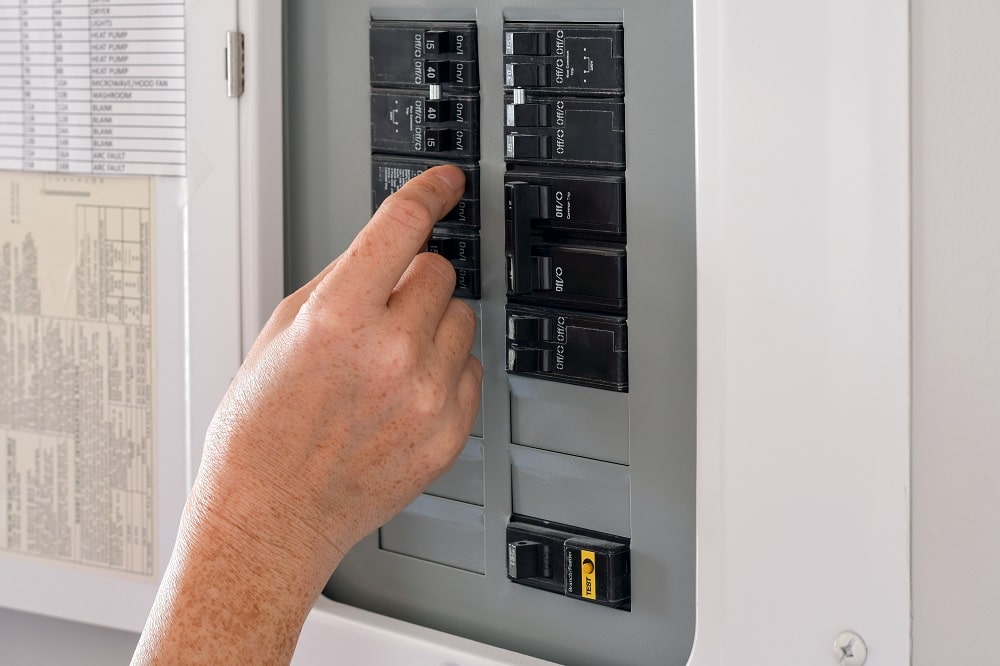
A refrigerator can usually be moved to a healthy circuit as a temporary measure. Medical equipment is a different matter and should follow its own manufacturer and emergency power instructions rather than being improvised onto another circuit. The affected branch should stay dead until the cause is known. The warning signs worth acting on immediately are described in how electrical fires start in homes and businesses, and a burning smell, a warm faceplate, or visible scorching moves this from a scheduling question to a same day one.
Which Faults Turn Up Most in Older New Orleans Houses?
Aged terminations and improvised extensions dominate. Decades of humidity work on screw connections and splices, and the metro’s housing stock has been extended, subdivided, and rewired in pieces often enough that a single circuit can contain several eras of workmanship in one run.
Specific patterns that come up repeatedly across the parishes: original circuits carrying loads that did not exist when they were installed, spliced connections outside a box in an attic, cloth insulated conductors that have gone brittle at the panel, and post flood repairs where a damaged section was replaced without the rest of the run being assessed.
Humidity is the quiet factor behind a lot of it. Corrosion at a terminal raises resistance, resistance produces heat, heat loosens the connection further, and the cycle continues until the circuit misbehaves. This is why intermittent tripping so often turns out to be a connection rather than a device, and why it features heavily in the repair calls that come in most often in this market.
When Does Repeated Tripping Mean the Panel Needs Replacing?
When the trouble follows the panel rather than the circuit. Several breakers misbehaving on different circuits, breakers that run hot, scorching at the bus, breakers that will not latch cleanly, or a panel type with a known reputation all shift attention from a branch fault to the equipment itself.
Load is a separate reason and a more common one. A circuit carrying more than it was designed for will trip legitimately and repeatedly with nothing broken anywhere. The fix for that is usually a new circuit or the load moved, not a larger breaker, since the conductors in the wall set the limit. A service upgrade helps when the whole house is short of capacity, and it does not on its own cure one overloaded branch.
Telling the two apart matters commercially as well as technically, because one is an afternoon of tracing and the other is a panel and service upgrade. A household that has already been told its panel is at fault is entitled to see which of those two conditions was actually measured, and the answer should come with numbers rather than an opinion. Where the answer is capacity, choosing the right breaker box becomes the next question.
How Long Does It Take to Trace a Tripping Circuit?
A straightforward fault on a well-mapped circuit is usually found within a visit. A circuit that has been extended informally over several decades, runs through an attic or a crawl space, and has no reliable directory can take considerably longer, because most of the work is access rather than diagnosis.
What shortens it is information the household already has. When did the tripping start, was there recent work anywhere nearby, does it correlate with rain or with a particular appliance, is the trip instant or delayed, and has anything changed on the circuit. Those five answers routinely remove hours.
What lengthens it is a circuit that has been reset dozens of times, because each re-energization can worsen the original damage or create a second fault alongside it. Calling early on a breaker that will not hold is the cheaper version of this job, and a household without power to part of the house in the meantime will find the practical steps in what to check when outlets stop working.
Frequently Asked Questions
Can a breaker itself be the reason it keeps tripping?
It can, but it is the last conclusion rather than the first, and the usual evidence is a breaker running hot while its neighbors are cool, or a circuit that measures normally under load while the device still releases.
Why does the breaker only trip when it rains?
Moisture reaching an outdoor receptacle, a weatherproof cover, or a damp junction creates a genuine leakage path to ground, so the device is detecting a real fault rather than behaving erratically in bad weather.
Should the main breaker be turned off before resetting a branch breaker?
It is not normally necessary for a reset. It is worth knowing that switching the main off de-energizes the load-side bus but leaves the service conductors and the line-side terminals live, which is one of the reasons work inside a panel is left to an electrician.
Can a tripping breaker damage appliances?
Repeated interruption is hard on motors and compressors in particular, and equipment that has been through many abrupt losses of power can fail earlier than it otherwise would even after the circuit is repaired.
Does an AFCI breaker trip for different reasons than a standard one?
Yes. An arc fault device is watching for the signature of arcing rather than only for current, so it can trip on a condition a standard breaker would carry, and it also responds to certain appliances and to damaged cords.
Is a breaker that trips once a month a problem?
A single trip under unusual load is not a concern on its own. A regular monthly pattern is worth measuring, because it can mean a circuit running close to its limit, and it can equally mean an intermittent appliance fault, moisture, a loose connection, or a tired breaker.
Can a homeowner replace a breaker in Louisiana?
Panel work is normally handled by a licensed electrician, and permit and licensing rules vary between Orleans, Jefferson, and St. Tammany, so the parish is worth checking. The practical reason is that the line side of the panel stays live with the main switched off.
Get the Circuit Traced Rather Than Reset
A breaker that will not hold is a live fault with a known location, and finding it is ordinary work when it is done in the right order with the right instruments. Big Easy Electricians maps the circuit, tests the fixed wiring before restoring any load, and gives a written finding rather than a verdict at the panel door. The estimate is free. Call 504-226-7555 or describe the symptom on the contact page, including whether the re-trip is instant or delayed, which narrows the cause before anyone arrives. Households wanting to understand what the device is doing when it releases will find it explained in how circuit breakers prevent electrical damage.